Review of William Dalrymple’s “In Xanadu”
This book is about William Dalrymple, at the age of 21 in 1986, retracing the steps of Marco Polo, traveling over land from Jerusalem to Xanadu in an extraordinary journey traversing Turkey, Iran, Pakistan, and northern China. The events in this book touch on many different cultures, histories, and landscapes, making it an amazing read. It also has just the right mix of humor, immersive descriptions of different places, and honesty about the difficulties of travel as well as the amazing things he saw. A note before continuing – there are some spoilers here for the sake of illustrating what the book is like, but nothing significant I hope.
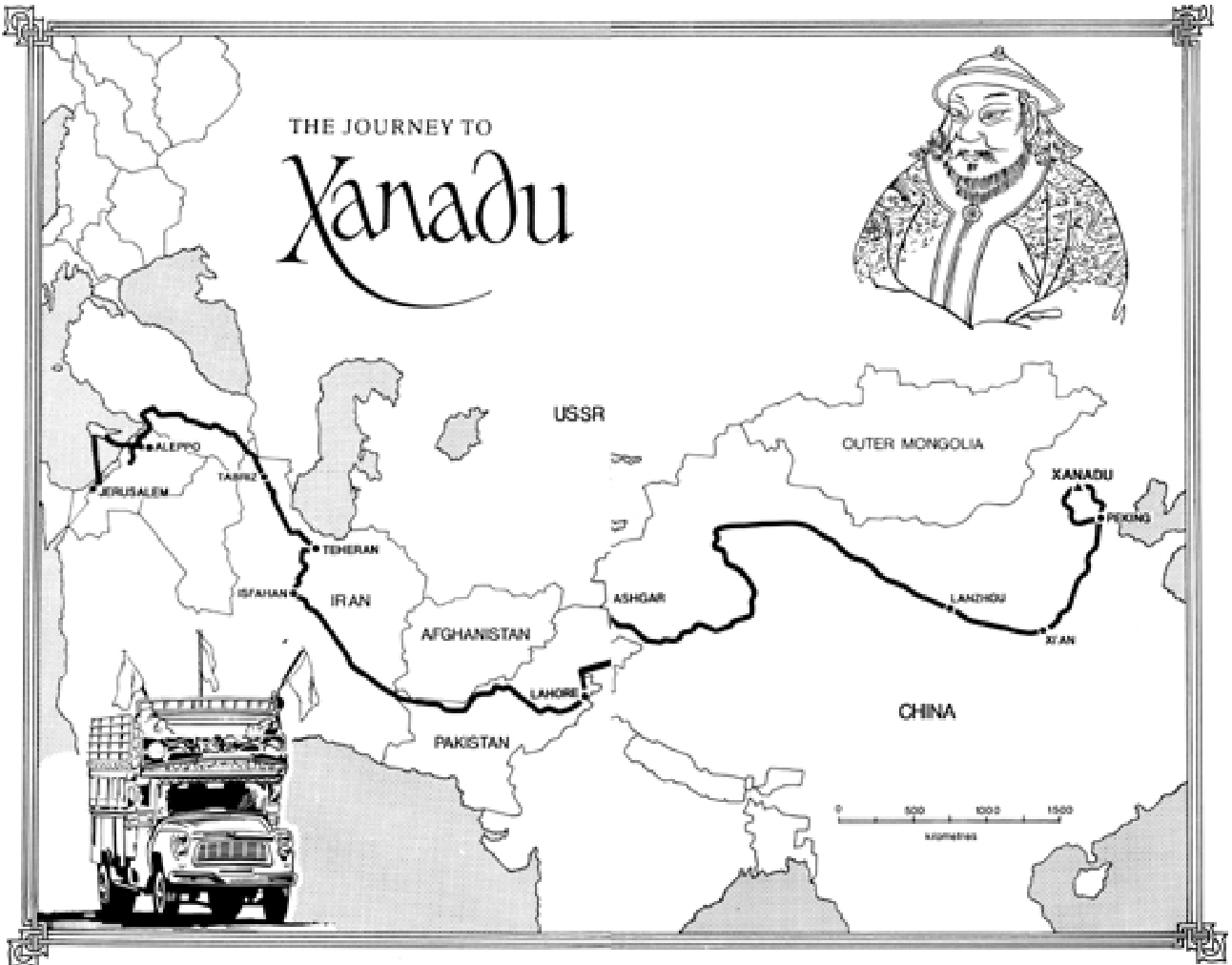
Map of
Dalrymple’s path, pulled from the book
The humor makes this book quite unique in its genre, since Dalrymple did a great job finding mirth in even the most dire circumstances, and he had lots of wild experiences to keep providing joke material. I was originally planning to include half a dozen examples of the funniness, but that would make this review too long, so here’s a sample of the Mr Flying Chicken episode:
Mr Flying Chicken was a gentleman of Singaporean origin who was remarkable chiefly for his kingly girth and his efforts to maintain it by constant feeding. Mr Flying Chicken was, appropriately enough, a seismologist. He was just returning to Peking after several months working on the earthquake problems of Urumchi. His company clearly valued the services of Mr Chicken for they had supplied him with all that was needed to keep him in good spirits for the duration of the journey, namely one very large hamper. This he tucked into with great enthusiasm. Before our eyes, in a matter of minutes, he consumed batteries of boiled eggs, bean curds barely unwrapped from their boxes, half-salamis imported at great cost from Italy, great lumps of dried pickled fish. These he washed down with cans of Chinese beer and inter-course slices of pineapple pie. But it was the poultry that was most dear to him. From a separate compartment in the hamper Mr Chicken produced a whole, cold boiling fowl. He lifted it aloft with the same reverence as a Catholic priest might lift the host at the elevation. He looked at Louisa and me with hungry eyes. ‘Fly Chikky,’ he murmured. After we had made friends with Mr Flying Chicken the journey turned into something of a dorm feast. He shared his poultry with us and in return we offered him a bag of melons we had bought in Turfan. As the afternoon went by we slowly ate our way through Mr Chicken’s hamper, until, sometime towards sunset we reached the bottom. Mr Chicken surveyed the empty hamper with great sadness. ‘No chikky, no agg, no pie-pie,’ he said. He picked at the pile of bones on the floor of the compartment, and looked around for something else to consume. There was nothing, and, as a glance at his watch revealed, it was more than two hours until the dining car opened. A look of infinite melancholy clouded his face.
Even though his journey is challenging at many points, his sense of humor keeps the book always entertaining to read. The above excerpt also indicates another laudable quality of the book: honesty to the point of horrific political incorrectness. I doubt this book could be written today without receiving complaints about racial stereotyping, homophobia, Islamophobia, objectification of women, etc – he at one point tried explaining “the Turks’ easy drift out of heterosexuality” as a result of Turkish women’s noses being too large, chins too prominent, and “baggy wraps concealing pneumatic bodies” (offensive to some? maybe. funny? absolutely yes). Goodreads has denounced this book as a manifestation of the patriarchy and cultural imperialism etc-etc, but I found it to be great humor that was respectful of other cultures’ wonders while also honest about what Dalrymple didn’t find as praise-worthy. If you want a bright young man’s honest assessment of his experiences traveling across the Middle East, Central Asia, and part of China, this is a great read that emphasizes both the positive traits of the people and the beauty of certain places along with the more unpleasant behaviors and uglier sights. Please ignore the nonsense on Goodreads – anyone familiar with Dalrymple’s other writing and his political beliefs should be well-aware that he is the furthest possible thing from a racist or an Islamophobe, and any use of racial stereotypes was solely for the purpose of humor. His brutal honesty draws controversy but in fact is what makes it so insightful about the many places he visited – you’re not just visualizing places and people, but also the thoughts and reactions Dalrymple had as he interacted with them. There is an admirable openness and irreverence in his tone.
I also enjoyed Dalrymple’s insight on history and architecture. He knew exactly which parts of history were most interesting to a lay audience and made centuries-old crusader lore very fun to read about. He gave fascinating context on topics as esoteric as the medieval Order of Assassins, Ilkhan Uljetu’s construction of the city of Sultaniya, its wonders and why it was doomed to fail after his death, and the chaos of the 1271 papal conclave. Dalrymple’s passion for the subject bleeds through the pages and makes the reader as excited as him. It’s fun to see someone so opinionated on Islamic architecture, completely dismissive of some buildings while awe-struck by others. He writes off the ones he dislikes, but when he finds a structure truly inspiring, he writes beautifully about it.
The mausoleum is octagonal, rising to a parapet from which springs a crown of eight minarets and a bee-hive dome. The sides of the octagon are not equal. There is a main front, once the climax of the Mall of Sultaniya. On it a central doorway is flanked by six blind arches, three on each side, once filled with faience-work inlay. The wall of tobacco-brick rises up to an open, arcaded gallery. This, as Byron pointed out, is a façade, a new departure in Islamic architecture. It was built primarily to be looked at. Unlike almost all earlier Islamic buildings which were bounded by walls and faced inwards, the tomb of Uljetu is centred on the dome and looks out. It is a public building, built at the centre of an imperial capital, a concrete expression of the Emperor’s power.
With its city decayed and its empire fallen, there could be something almost pathetic about so proud and vain a monument. Yet the building still retains great dignity and power. This is especially so of the interior. Nothing, except perhaps Hagia Sophia, prepares one for the sheer scale of the vast, unsupported, heavenward-thrusting dome. It encloses an enormous space, far greater than one would expect from the outside. It dwarfs the observer.
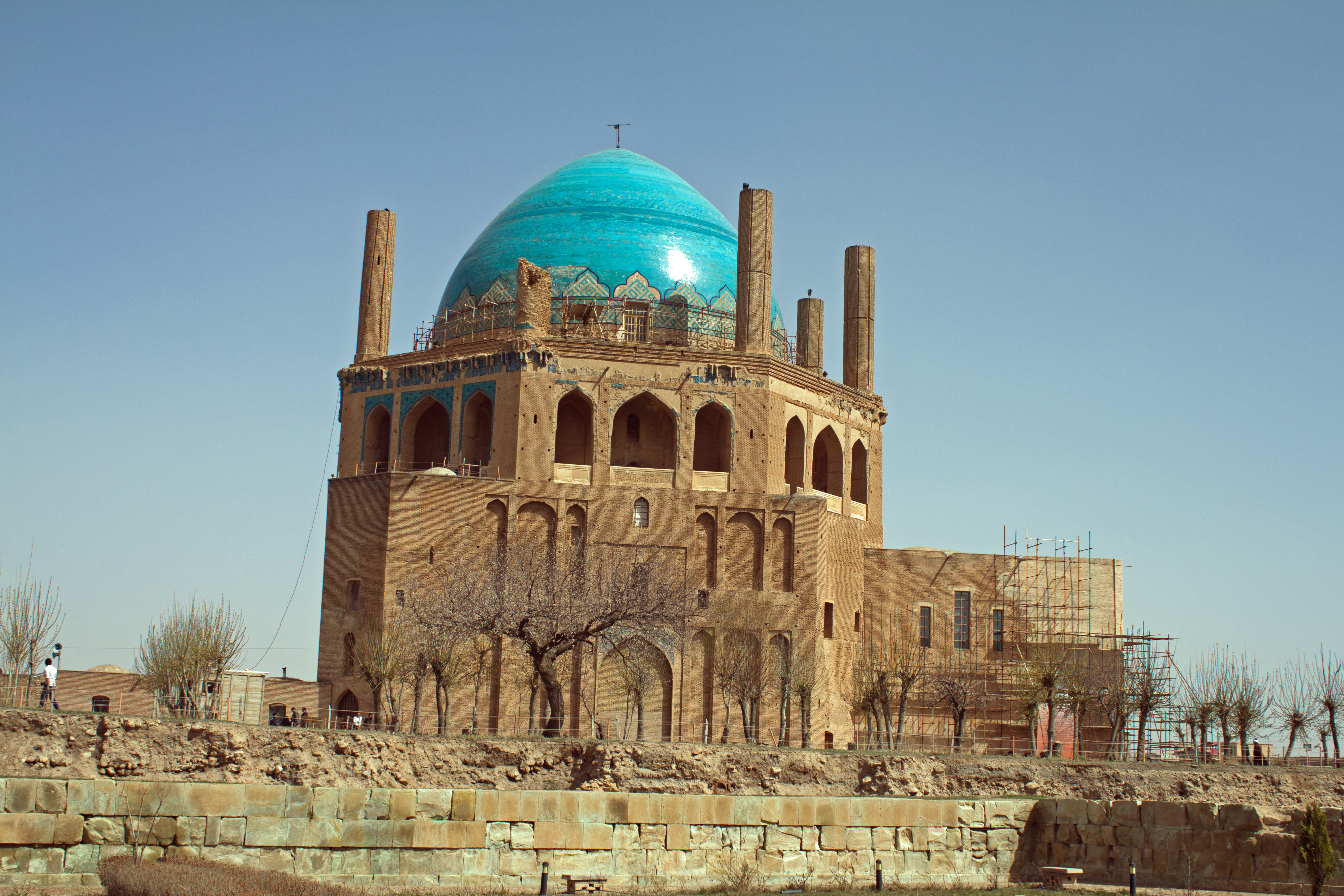
Picture of the Soltaniyeh mauseoleum Dalrymple praised, taken from
Wikimedia
Commons under GNU Free Documentation License

Dalrymple’s extensive knowledge of history and architecture, combined with his passion for both subjects, makes the book both educational and fun to read, packed with descriptions of beautiful mausoleums and castles and the gory history accompanying them.
Although much of this book focuses on the history of Marco Polo’s times, the dramatic political changes of the 20th century forced Dalrymple to also address some more recent issues, and his insight into these topics is equally fascinating. He meets with an Armenian priest in Iran, who complains of the Shah’s destruction of old gardens and merchant’s houses in favor of modern, western-looking high-rise developments, but then emphasizes “at least people used to have fun in the Shah’s days” and complains of Khomeini replacing cinemas with revolutionary lecture theatres and bars with non-alcoholic carrot milk shakes. Dalrymple also personally experiences the hardships of Sharia law, and his female companion Laura was forced to wear a chador throughout their time in Iran and pretend to be Dalrymple’s wife. In Xinjiang, he meets an educated Muslim who tells him about the suppression of the Uighur language and Islam, as well as his personal difficulties of being “over-educated for the taste of most Muslims” but “considered old-fashioned and backward by his contemporaries at university.” In Israel, he describes the tensions between Arabs and Jews through his conversation with an Arab tailor complaining of the dual legal system and discrimination against Arabs, as well as his disturbing conversation with two urbane, seemingly-liberal Jews who then shocked Dalrymple with their full-throated support for illegal occupation of Jordanian territory. Lots of interesting glimpses of what these places were like (many still relevant today), combined with Dalrymple’s own eloquent interpretation of all this history.
For two thousand years Jerusalem has brought out the least attractive qualities in every race that has lived there. The Holy City has had more atrocities committed in it, more consistently, than any other town in the world. Sacred to three religions, the city has witnessed the worst intolerance and self-righteousness of all of them.
Dalrymple’s description of recent history and the state of affairs at the time of his traveling serves as an amazing window into what these parts of the world were like in 1986. Aside from depressing political developments, Dalrymple’s description of landscapes is enchanting. He traveled through deserts, fertile plains, and mountains and captured the beauty of all of them with a writing style that blurred the lines between poetry and prose. Even when he was at his most opinionated and cynical, he did a great job creating a picture of what he was witnessing.
As we drove on the landscape became harsher still. The scrub turned to sand and the shallow line of mountains that formed the horizon to our right dipped lower and lower and then hit the plain. There was a gap, a last craggy outcrop and then nothing. Never has a landscape filled me with such a sense of melancholy. It felt as if some terrible biblical disaster had taken place, that its inhabitants had been caught committing sodomy or castrating Israelites, whereupon fire and brimstone had rained down from the sky, leaving only a few dazed-looking nomads and an awful lot of sand.
Also praise-worthy is the sheer amount of adventure Dalrymple had: multiple run-ins with the police in countries governed by authoritarian regimes, alone and lost on a remote mountain where he stumbles upon a pre-Islamic animistic ceremony and pontificates on the symbolism of standing where Alexander the Great fought his last siege, and accidentally wandering into the the Chinese nuclear testing ground in the desert of Lop. It’s impossible to put down, and I’m simply in awe of how lucky this guy was at surviving his own recklessness. It isn’t all exciting, and there are also long segments where Dalrymple is exhausted, bored, and depressed by the hardships of traveling in the bed of a coal truck while keeping his head down to hide from military patrols (arguably itself an adventure); but even then, his eloquence and humor keep the book interesting.
All in all, 10/10 read. Fantastic descriptions of people, places, history, and architecture. Fun, informative, sometimes hilarious, and never a dull chapter. I highly recommend it if you like travel writing.