My Thoughts on The Recent Student Protests in India
Disclaimer: this post links to social media posts as sources, since much of the footage from the protests is only available there. I have only referenced posts that come from credible journalists, the official accounts of news organizations, and prominent political parties/organizations. However, given the amount of disinformation/misinformation that circulates during events like this, treat these sources with the appropriate level of skepticism.
The student protests triggered by the recent NEET exam leak are one of the most significant mass movements in the last few years of Indian politics. They’ve received an unprecedented amount of support from the public, aided in part by the police’s brutal treatment of students that makes it difficult to sympathize much with the government. However, as with most political questions, this isn’t a black-and-white case of “students good, government bad.” This post covers both the promising developments as well as the negative trends during the protests.
Police and RAF Misconduct in Delhi
The Delhi police’s actions have drawn widespread condemnation (deserved), but little effort has been made by the public to understand why the crackdown occurred. Therefore, I will begin by explaining the strongest possible rationale for the crowd dispersion, one I think is actually strong enough to justify clearing protesters from the area directly surrounding Parliament.
Given the anger the protesters had towards the government, the unruliness of the crowd, and the inability to check protesters for weapons or criminal backgrounds, there were valid concerns about the security risks resulting from several thousand people descending on the Lok Sabha while Parliament was in session. The police’s job is to enforce the country’s laws and ensure people are kept safe from violence. A situation where several thousand angry people surround the country’s legislators, where zero screening is done for arms or criminal background, creates a significant risk of physical harm being done to members of parliament. The rationale is not “all the protesters are anti-nationals” – most were students exercising their right to non-violent protest – rather, that a non-zero number of them could be dangerous and, given the inability to distinguish between nonviolent and ill-intentioned protesters, the government had no choice but to deny them the ability to enter Parliament. When protesters ignored that government guidance, it became the police’s duty to prevent the risk of violence against MPs.
There is also the issue of intimidation being used to influence voting. If the police set a precedent of allowing thousands of people to stream into Parliament and protest without any screening of the people entering, bad actors could in the future use this as a tactic to intimidate MPs into voting according to their own interests. Today, the public thinks the protesters should have been let in, since they sympathize with the cause and believe that the exam leak was handled poorly. What happens if, a few years later, thousands of protesters flood into Parliament to call for the revocation of Muslims’ citizenship and the denial of welfare benefits to them? Surely, the presence of a large, unruly mob presiding over a vote might induce some legislators to vote according to the mob’s wishes rather than their own values and beliefs. What, then, is the government to do? Should these hypothetical protesters be denied entry to Parliament, but today’s student protesters be allowed in, because one group’s demands are more palatable to the general public? The law must treat everyone equally – allowing some protests while banning others, solely on the basis of the ideologies involved rather than the methods, is a fast path towards authoritarianism in which some people’s speech is worth more than others. Therefore, to avoid setting a potentially catastrophic precedent of permitting intimidation of MPs, it is essential to prevent protesters from entering Parliament.
This is the most sensible rationale behind the order being given to clear protesters out of the area in front of Parliament – note that this is the ‘most sensible’ rationale rather than the one they actually used, which could potentially be much less robust. Then, once the order is given, individual policemen must discharge their duty and use appropriate methods to remove protesters from the area. Thus far, all of this follows logically and is consistent with the values of a liberal democracy. However, as with most things, the devil is in the details, and it is the manner in which protesters were removed which deserves universal outrage and condemnation.
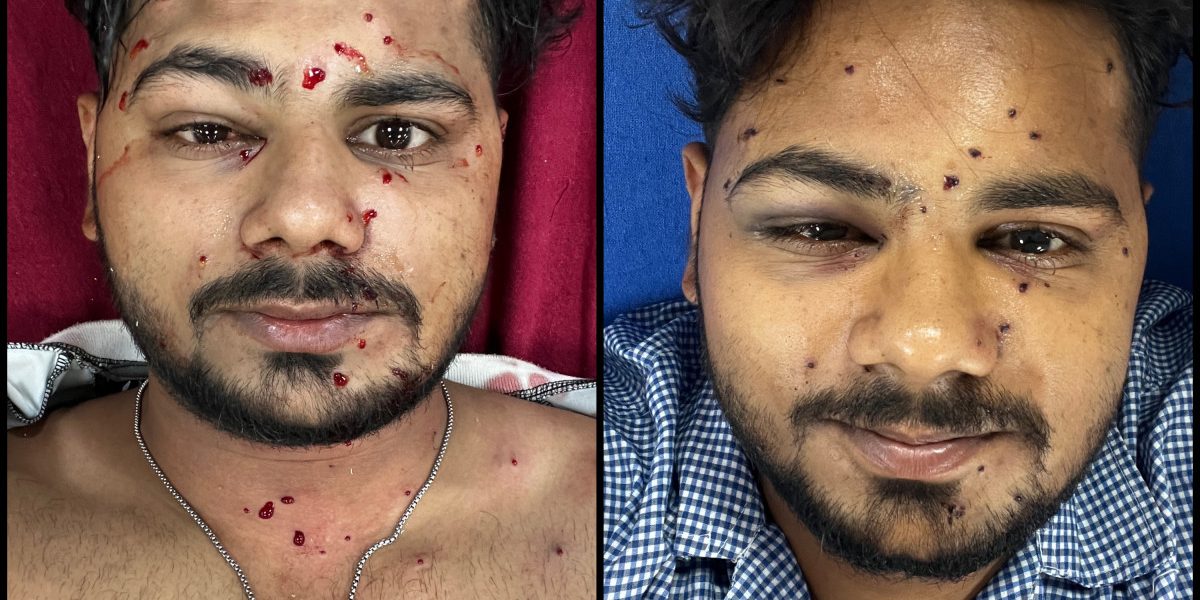
The Delhi police’s response to this protest used excessive force and brutality. Pellet guns and shock batons were used by the Rapid Action Force (RAF), a first in the history of Delhi, against unarmed protesters who posed no imminent threat to public safety. Lathi charges were proving sufficient to disperse protesters, and the RAF had no rationale for employing this level of force when less violent methods were clearly working. Pellet guns can cause life-long blindness and psychiatric disorders and, in the short-term, cause excruciatingly painful injuries that require surgery to fix. The Supreme Court has previously issued guidance on the need for pellet guns to only be used as a “last resort” and with application of mind, but evidently, the central government has not appropriately ensured that the Court’s guidance is followed. Shock batons are another example of excessive force: electric shocks cause a level of pain and trauma that is closer to punishment than ordinary crowd dispersal, and there is no sensible reason for using them other than incompetence or outright cruelty.
“I was thinking the jawan in blue dress (RAF) had a weapon aimed at me. I presumed he was just posing and was not supposed to fire. Suddenly, an object struck my left eyebrow, and it scattered. I could feel the particles on my face, lower right chin and neck,” Irshad told the family member, who narrated the account to ThePrint.
“Pellet remnants were removed from his body in two surgeries in his neck and eye conducted Tuesday,” said a source privy to his treatment.
Recalling what unfolded later that day, Irshad told a family member: “I was pleading, with folded hands, along with several others, before them (security forces), that please don’t use weapons on us. We are youth and just raising demands for education.”
The next thing Irshad remembers, as the family member told ThePrint, was blood oozing out of his left eye. Within seconds, the injury spread to his lower chin, shoulder and chest. The 25-year-old from Madhya Pradesh was rushed to nearby Lady Hardinge Hospital where he is currently recovering. It was here that he was told he had been hit with a pellet gun. (from an article in ThePrint.in)
There are also claims that some police officers threw stones at protesters, as shown in this Cockroach Janata Party (CJP) video, which certainly is not ‘proportionate force’ or standard police conduct:
Why are the Police pelting stones at protesters? Was the brutal lathi charge not enough?
— Cockroach is Back (@Cockroachisback) July 20, 2026
Shocking visuals coming from Delhi pic.twitter.com/8QF2SyG7gP
One of the most disturbing cases of police brutality in Delhi is that some police used batons studded with nails to beat protesters. The Delhi police and Press Information Bureau of the Union government both issued ‘fact checks’ claiming the videos (now made unavailable in India, in yet another attack on freedom of speech) “are not related to yesterday’s protest” and offered no evidence to back up their claim, but TheWire.in and Alt News have issued their own fact checks that actually have evidence, including video metadata, identification of the police officer involved, and confirmation that the place shown in the video was in Delhi. Nail-studded batons are an inhumane and cruel form of crowd dispersal that can not be justified in a liberal democracy, and they can cause significant injury to protesters.
With or without nails in the batons, there are multiple credible accounts of Delhi police and RAF hitting protesters in the head, such as this video posted by the content creator PeeingHuman showing a head wound with heavy bleeding (verified by Hindustan Times). Beating people on the head with polycarbonate batons and/or wooden batons studded with nails can cause life-threatening injuries and permanent disabilities, making this a clear case of excessive force. It is also difficult to claim these injuries are the result of police accidentally hitting too high while otherwise exercising caution – videos show a consistent pattern of police wildly swinging with batons rather than aiming for soft parts of the body (as they are supposed to), and it is difficult to see how head wounds could accidentally occur if police were making an active effort to aim lower on the body.
Apart from the use of unusual and inhumane weapons against unarmed protesters and the haphazard manner of beatings, the lathi charges exhibited unnecessary brutality in many other ways. Protesters were beaten indiscriminately – videos show that most of the victims of police beatings were either standing still or fleeing, some were even beaten after already having fallen to the ground from the first few blows, and most were not throwing stones, charging at Parliament, or attacking police. Unlike some of my other posts, I can’t quantify what % of protesters beaten were engaging in violence or not, but I invite you to review some of the videos shared by journalists and decide for yourself whether this constitutes ‘proportionate force.’
"It is informed that no such incident has taken place and the protest is being handled professionally" https://t.co/EH5SUf4I4k https://t.co/yjasaf1lcX
— Piyush Rai (@Benarasiyaa) July 20, 2026
The scale of police action was unprecedented by all measures. This could have easily escalated into stampede. What was Delhi police trying to do? https://t.co/TINzEhcv4i pic.twitter.com/Pmp0FaiRTA
— Piyush Rai (@Benarasiyaa) July 20, 2026
The Lok Sabha Leader of Opposition (LoP) Rahul Gandhi was dragged by his feet by Delhi police and left with a bloody nose. Former chief minister of Punjab Charanjit Singh Channi was carried away by police holding him by his armpits and then taken into custody, in a video published by Asian News International (ANI). Former MLA Akhilesh Pati Tripathi, who had recently undergone an intensive brain surgery, was roughly thrown upside down by police, in a video shared by Aam Aadmi Party president Saurabh Bharadwaj. The police chased and beat protesters even as they were fleeing, and journalists from Scroll.in present at the scene have claimed they were making no differentiation between protesters and journalists. Videos posted by TheWire.in show their reporters frantically screaming “media media media!” as police swing their batons with no differentiation between protesters standing in one place and not advancing towards Parliament, protesters already running away from Parliament, and members of the press. Outlook Magazine has also reported that one of its reporters was wounded in the arm by a pellet gun.
CJP Protest | Police Used Force on Protestors in Delhi's Cannaught Place pic.twitter.com/aXwjBashUu
— The Wire (@thewire_in) July 20, 2026
Remarkable scenes at Delhi's iconic Connaught Place as police beat and chase students asking for the Modi government to end question paper leaks.
— shoaib daniyal (@ShoaibDaniyal) July 20, 2026
[The shaky bits in the middle is me running, given the police were in no mood to differentiate between protesters and journalists.] pic.twitter.com/ZMPxgvoKDj
Look at Cruelty
— Saurabh Bharadwaj (@Saurabh_MLAgk) July 20, 2026
This man who has been thrown upside down is a 3 time MLA @AapAkhilesh_ of @AamAadmiParty.
He had undergone a very intensive brain surgery after road accident. And now this.
Is this way to treat people ? pic.twitter.com/KVoFtiLW9s
The level of force used by the Delhi police is inexcusable. The Lok Sabha LoP, former MLAs, and a former chief minister are not the kind of people likely to turn violent, and videos show they indeed were not using violence. Why, then, are nonviolent protesters being thrown upside down onto police barricades? The Delhi police has not provided a satisfactory answer to this question, and no satisfactory answer is forthcoming because it is clear they made insufficient effort to control their forces, allowed a complete breakdown in discipline, and created a situation where excessive force was not the outlier but the norm.
The Delhi police and the RAF also created a situation in which officers can not be held accountable for their actions, which incentivizes brutality by creating an environment of impunity in which excessive force can be used without fear of legal repercussions or investigation. A reporter from Lallantop asked an RAF officer why officers removed their name tags from their uniforms – a serious irregularity that makes it difficult for victims of excessive force to hold officers accountable and have them investigated. The officer replied that name tags are attached to the uniform with velcro, creating the risk of name tags falling off the uniform due to contact with the riot gear and then falling under someone’s foot, threatening “post ki dignity.” Notably, epaulettes (a sign of rank that is equally important to ‘post ki dignity’) were still attached to the uniforms, although the reporter did not highlight this. The Lallantop reporter did, however, point out that officers who had removed the riot gear were also roaming around without name tags, to which the officer responded that they had done so because of the heat – evidently, she didn’t see the contradiction between name tags being removed because of riot gear, but also being removed even without riot gear on. She then rhetorically asked what reason the officers could have to hide their identity and said “hamari identity yaha likhi hain” while pointing to the CRP label on her uniform – a poor strawman, since the reporter was clearly not asking about ‘identity’ in terms of ‘who do you work for,’ but instead in terms of ‘who actually are you.’ It does not matter if a protester knows that the officer beating them is a member of the RAF, what matters if that they know the officer’s name and can later sue them in court – the fear of legal repercussions is a crucial factor in preventing the use of excessive force, and once that fear is removed, brutality is effectively being incentivized. The refusal to wear name tags, poorly justified by ‘post ki dignity,’ reflects a lack of interest in preventing the use of excessive force by creating the necessary framework of accountability.
The lack of accountability goes beyond RAF officers not wearing name tags. The Delhi police used plainclothes officers to beat protesters, again eliminating accountability and thus increasing the probability of excessive force being used (as did occur throughout the crackdown). The police’s response is interesting because it ignores the main concerns about accountability and also shows a fundamental misunderstanding of the role of plainclothes officers.
“They are from the special staff and from the teams which are not part of active policing duties. This is not illegal deployment. However, they are deployed in law and order duties as reinforcements during situations such as yesterday’s, and it was neither illegal nor unprecedented,” a senior police officer told ThePrint.
Plainclothes officers are a normal part of policing, but they are typically used for collecting intelligence for future prosecution and/or investigation that wouldn’t be obtainable if they identified themselves as police – an understandable and reasonable use case. However, anonymity has no value when making an arrest – a criminal is as likely to resist arrest against a police whose name tag they can see, as they are likely to resist arrest against one whose name they don’t know. In fact, permitting anonymity during arrests and use of force creates a dangerous risk of people impersonating officers – how is someone to know that they are being arrested or beaten by an actual plainclothes cop rather than some miscreant? Therefore, police are required to identify themselves as officers when making arrests, a standard laid out in the 1997 Supreme Court case DK Basu vs State of West Bengal:
The police personnel carrying out the arrest and handling the interrogation of the arrestee should bear accurate, visible and clear identification and name togs with their designations. The particulars of all such police personnel who handle interrogation of the arrestee must be recorded in a register.
Granted, this does not address police beating people during riot control and only focuses on arrests. However, the principle still applies – why should a police officer’s order to disperse have any weight if he doesn’t identify himself as a police officer? How can a police officer be held accountable for excessive force, similarly to with wrongful arrest, if he doesn’t provide his name? Or, as this Indian Express article put it:
The maintenance of public order and tranquillity is governed by Chapter XI of the BNSS (Sections 148 to 160, formerly Chapter X of the CrPC). While it does not specifically state whether policemen or armed forces personnel are required to identify themselves during a law and order situation, sources said, the very fact that the law allows only a magistrate or a “police officer” to disperse a crowd implies identification. The argument is that an unidentified crowd of armed men cannot legally demand a public gathering to disperse. “If a police officer is unidentifiable, his command to disperse cannot carry statutory weight,” said a criminal lawyer practising in Delhi.
The Delhi police is correct that their use of plainclothes officers isn’t necessarily ‘illegal,’ but it certainly is ‘unprecedented’ and a reason to worry about the lack of accountability for excessive force being used. The dismissive nature of this response and refusal to understand people’s legitimate concerns about a legal grey area is disturbing.
If the RAF and Delhi police’s actions aren’t evidence enough of the widespread brutality and lack of professionalism, their speech and thoughts further prove that they were not conducting the lathi charge in a professional, non-partisan manner. RAF Assistant Commandant Sonia Sehrawat, who was deployed in Delhi to disperse protesters, posted an image of a dead upside-down cockroach captioned “CAN’T FIX THEMSELVES AND THEY WANNA FIX THE COUNTRY” shortly after the police actions in front of Parliament.

Police and paramilitary forces are supposed to carry out their duty with the minimum amount of force while acting purely on the basis of orders rather than personal feelings towards protesters. This Assistant Commandant’s post is indicative of a failure to establish that separation between duty and personal beliefs, and the brutal nature of the lathi charges suggests she is not the only one who is guilty of this.
When all this evidence is viewed collectively, the police and RAF’s actions in Delhi show use of unjustifiable brutality, enabled by a lack of accountability, no legal circumscription of their powers, and no separation between duty and personal beliefs.
Erosion of Constitutional Rights to Freedom of Speech and Assembly
While most media coverage has focused on Delhi, the government authorities and police in other parts of India also took very questionable decisions while shutting down the student protests. In Mumbai, people were denied permission to stage a peaceful protest at the Chaityabhoomi park. The very idea of asking permission for protests is problematic, since it can easily become a form of prior restraint (see this article by Anand Teltumbde in TheWire.in). The Constitution guarantees the right to peaceful assembly and free speech under Article 19, yet as with most of the Indian Constitution, there’s a big “if” included that effectively neuters these constitutional guarantees.
Nothing in sub-clause (a) of clause (1) shall affect the operation of any existing law, or prevent the State from making any law, in so far as such law imposes reasonable restrictions on the exercise of the right conferred by the said sub-clause in the interests of the sovereignty and integrity of India, the security of the State, friendly relations with Foreign States, public order, decency or morality or in relation to contempt of court, defamation or incitement to an offence.
As noted in my post on preventive detention laws in India and my post on Himanshu Jangra and freedom of speech, words like “sovereignty and integrity of India,” “security,” “public order,” and “decency or morality” are vague, lend themselves to varying interprations, and create huge loopholes for interpreting all kinds of speech as inimical to these values. The process of seeking permission for protests suffers from exactly this issue – what is the standard for judging some protests dangerous to ‘public order,’ who gets to decide, and what is the decision process like? The Constitution is vague in this regard, despite having opening a giant legal Pandora’s box, and the courts have not helped set a clear precedent either. This has allowed the Lok Sabha and state assemblies to pass laws that grant immense power to police departments and executive magistrates to circumscribe these fundamental rights.
Section 163 of the BNSS allows Executive Magistrates to prohibit large assemblies (and pretty much any other action) if they arbitrarily decide it’s for the greater good, conferring extraordinary powers upon individuals while creating no standards for accountability, due process, or the ability to quickly and easily challenge these decisions.
In cases where, in the opinion of a District Magistrate, a Sub-divisional Magistrate or any other Executive Magistrate specially empowered by the State Government in this behalf, there is sufficient ground for proceeding under this section and immediate prevention or speedy remedy is desirable, such Magistrate may, by a written order stating the material facts of the case and served in the manner provided by section 153, direct any person to abstain from a certain act or to take certain order with respect to certain property in his possession or under his management, if such Magistrate considers that such direction is likely to prevent, or tends to prevent, obstruction, annoyance or injury to any person lawfully employed, or danger to human life, health or safety or a disturbance of the public tranquillity, or a riot, or an affray.
Again, we have these vague words that give corrupt or partisan magistrates extraordinary powers to restrict freedom of assembly with shallow justifications: the threshold for proving risk of “obstruction” and “annoyance” is quite low, since all protests tend to obstruct people’s movement to some extent and always annoy some people.
In the case of the Mumbai protests, it certainly appears that the police took advantage of their vast powers (granted under the Maharashtra Police Act) to prohibit the protest with little rationale. Unlike Parliament, Chaityabhoomi is a public space that isn’t integral to national security and the functioning of democracy, and a large, slightly unruly crowd at Chaityabhoomi is not the end of the world. The police’s rationale was therefore rooted in some very odd, poorly-explained fears:
WHEREAS, based on the information from various sources, it is apprehended that there is likelihood of breach of peace and disturbance of public tranquility and also there is grave danger to human lives and loss of property. On that account, it is considered expedient to issue prohibitory order for restricting movement and unlawful assembly of five or more person for prevention of breach of peace, disturbance to public tranquility and danger to human lives and loss of properties and to prevent any kind of riot or affray
They could not have gotten any less specific: citing “various sources,” “breach of peace,” and “disturbance of public tranquility” is not sufficient evidence for proving a danger so great that it justifies prohibiting the constitutional right to freedom of speech and assembly. The Mumbai police has effectively made the idea of these ‘rights’ meaningless by exercising its powers in such an arbitrary manner. In case you weren’t yet convinced that their case is nonsensical, let’s consider the people they actually ended up arresting when going after those intending to protest anyway: a terrifying total of 300 protesters, some of whom were minors as young as 11 attending with their barely-older teenage siblings. This hardly seems like the hordes of chaos and destruction which the Mumbai police alluded to in their circular.
It is also worth noting that some children in Mumbai were detained merely for being near Chaityabhoomi, even after repeatedly saying they were not protesters, and that some lawyers were not allowed to meet their clients. Three lawyers reported being themselves detained after being summoned to police stations, with no cause given. There are also reports that the police indiscriminately picked up activists and students from around the city, regardless of whether they were anywhere near the protest site. The Mumbai police’s justification for denying permission for the protest was already flimsy, but the violation of civil rights makes their conduct even more problematic.
Restrictions on freedom of movement were also imposed at the Punjab-Haryana border, where police erected multi-layer barricades to prevent peaceful protesters from reaching the Delhi rally and exercising their constitutional right to freedom of speech and assembly. This bears striking similarities to how the government handled the 2020-2021 protests against the Farm Bills: putting up barriers and digging up roads to block protesters’ path to Delhi, branding them ‘anti-nationals’ associated with the ‘tukde-tukde gang,’ and refusing to give way for over a year (during which time the farmers endured the Delhi winter while on the road) before finally repealing all three bills (see Chapter 7 of Aakar Patel’s ‘Price of the Modi Years’).
The rights to freedom of speech and assembly are fundamental rights, and the government’s arbitrary and often absurd restriction of them shows that we are living under an authoritarian regime where basic freedoms are being restricted. The low (read: nonexistent) legal threshold for justifying the circumscription of these rights has always been problematic, and the police’s actions in the latest student protests are yet another glaring example of that.
The Police and Delhi High Court’s Handling of Sonam Wangchuk’s Hunger Strike
The police and Delhi High Court’s handling of Sonam Wangchuk’s hunger strike also involved serious attacks on personal liberties. Police forcibly moved him from Jantar Mantar, where he was on hunger strike, to Safdarjung hospital on July 18, 2026, acting on orders from the Delhi High Court. He was then kept there against his wishes, despite submitting a handwritten request to be temporarily discharged to attend the march to Parliament. When the request for discharge failed, Wangchuk’s wife, Gitanjali Angmo, appealed to the High Court to allow his transfer to Medanta hospital, citing serious irregularities in his treatment such as heavy surveillance, restrictions on freedom, a lack of transparency in sharing Wangchuk’s vitals, and allegedly “medically impossible” reports of his potassium levels that were contradicted by an independent report. Although the High Court eventually permitted his transfer (note that a discharge was still refused), it is absurd that a High Court’s permission is required for people to do things as basic as switch hospitals or be discharged under the Leave Against Medical Advice provision (see more on that here). Even though their reasoning was legally sound – only thanks to the Constitution’s vague and often contradictory provisions that allow significant government overreach – the fact remains that the current legal framework is antithetical to the individual agency and liberty that must exist in a democracy. The government may disagree with a citizen’s chosen form of protest, but using medical justifications to curtail fundamental rights sets a dangerous precedent in which the right to protest is rendered meaningless.
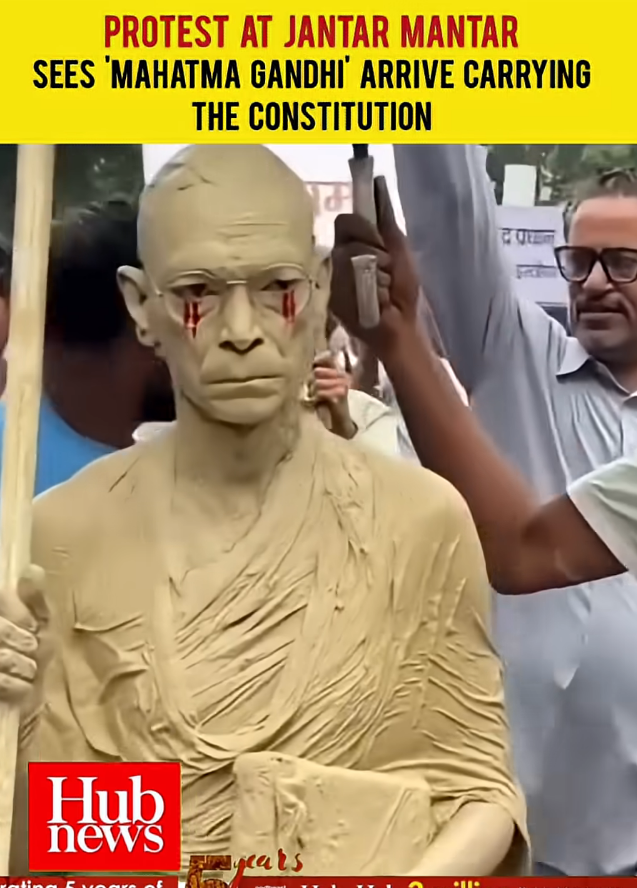
Aside from the moral and practical implications of such policies, it is striking that the government of independent India, whose very existence was made possible partly by M.K. Gandhi’s hunger strikes, is now choosing to curtail its own citizens’ right to fast as a form of protest. This irony was not missed by the Delhi protesters, one of whom dressed as Gandhi himself, carrying the Constitution and a walking stick while crying tears of blood.
The Conduct of the Protesters
The protest in front of Parliament began as a peaceful demonstration, and even till the end, a large number of the protesters retained their composure and did not turn violent. However, there were many cases of stone-pelting, attacks on police officers and RAF personnel, and vandalism of police vehicles. In a protest led by angry young men who have endured lathi charges and tear gas for hours, it is unavoidable that some people will lose their temper and turn violent – I wish it were not so, but the impulse control of the average human is just not high enough for my ideal world. But even if police violence can explain why protesters felt driven to violence, that does not justify it.
Respect for law enforcement is the basis for rule of law in a society – apart from reasonable and proportionate self-defence, protesters should not become physically violent towards police, even if they are using excessive force. Spontaneous bursts of retaliatory violence create a world in which violence is an ever-escalating, endless cycle where the government loses the ability to maintain the rule of law and protect citizens. Although the police have abused their power in Delhi, the situation is not so severe that it calls for anarchy and vigilante justice, which is what the violent protesters were intentionally or unintentionally contributing to. India is a country with an authoritarian government, but justice is not yet completely impossible through the court sytem. The Delhi High Court has already ordered that CCTV footage and videos of the Delhi protests be preserved and announced a hearing date of September 11 for petitions related to police brutality. As harsh as it sounds, protesters should have endured the blows raining down on them without themselves retaliating violently, and instead gone to the courts for seeking justice.
Aside from the dangerous macro implications of permitting vigilante justice against law enforcement, stone-pelting is also a particularly ineffective method of seeking justice that reflects anger and a blind desire for revenge more than genuine interest in punishing officers guilty of using excessive force. Stone-pelting has low accuracy and usually ends up hitting people completely unrelated to whatever injustices were committed against the aggrieved protesters. Many online commentators are praising the stone-pelters and saying the police deserved it because of their brutality, but the reality is that we have no idea whether the people hit by stones were actually the officers using pellet guns and batons with nails, or if they were actually using proportionate force. Of course, nobody deserves to be violently assaulted by a mob as ‘justice,’ but it can’t even be said with confidence that the victims of stone-pelting were deserving of any punishment at all, be it judicial or vigilante. Stone-pelting is a retributive form of vigilante justice that shows no regard for due process and frequently impacts people completely uninvolved with police brutality, and this should be condemned.
Equally disturbing are the attacks on journalists, motivated by anger at pro-BJP news channels’ partisan coverage of the protests. Journalists have been kicked, hit, and pushed to the ground by large mobs who felt wronged by their channels’ coverage of the protests. This kind of behavior is as inexcusable as stone-pelting. In a society with free speech, reporters and news channels have the right to report the protests however they want, even if they are partisan, unfair, or misleading. I dislike the godi media as much as anyone, and they have covered the protests in a very biased manner (more on that later), but violence is not the correct way of combating disinformation. Protesters have the options of engaging with journalists from more neutral channels, creating social media content to relay their own version of the story, and fact-checking biased channels’ more absurd claims – these are all good strategies for fighting disinformation, but violence against journalists is counterproductive and just wrong.
Dev Kotak, a reporter with Times now, was attacked by a mob of protesters at Jantar Mantar in New Delhi. This is absolutely disgraceful. You can request a reporter to leave the spot if you don't want him/her around but resorting to violence is absolutely unjustified. pic.twitter.com/wCsTEswJ8t
— Piyush Rai (@Benarasiyaa) July 21, 2026
Despite this disappointing conduct from some protesters, most of the people who showed up were nonviolent and deserve praise for keeping their composure while braving tear gas and lathi charges to fight for their beliefs and try to build a better future. It was inspiring to see so many young people show such courage and commitment to creating a fairer world for India’s young. I don’t approve of all the tactics used by the CJP – the decision to get so close to Parliament is rather problematic in my opinion – but the idealism, bravery, and integrity of the protesters is admirable. I think their protest has also had a net positive impact on India – the issue of exam leaks has been put in the spotlight, the government is now less likely to get away with sweeping their failure under the rug, and the likelihood of a comprehensive reform of exam administration has increased because of students’ involvement with the issue. This has, of course, come at a heavy cost: a countless number of people injured, bruised and bleeding from police batons, and traumatized by their first encounter with the power of an authoritarian state. But these students’ sacrifices will hopefully pay off.
Traditional Media vs Social Media
Many traditional media houses’ coverage of the protests was partisan and misleading. Republic World posted a video on Youtube titled “CJP Protest: Arnab Exposes Abhijeet Dipke’s Deep State Riots At Jantar Mantar | Delhi,” and the few clips I’ve seen of their TV coverage suggest this is the entirety of the narrative they showed: anti-nationals, foreign conspiracies, and attacks on Bharat Mata. Here is an excerpt from that Republic World video’s description:
Arnab Goswami exposes the real motive behind Abhijeet Dipke’s CJP protest that turned into a violent riot at Jantar Mantar and surrounding areas in Delhi. What was projected as a student-led agitation is actually a carefully staged event backed by foreign-funded elements and deep state actors. Despite repeated appeals by Delhi Police to maintain peace, the so-called protesters attacked police and RAF personnel with stones, injured over 118 officers, and vandalised government vehicles. Arnab reveals how Dipke’s CJP is being used as a tool to create chaos near Parliament and destabilise law and order.
The real motive, according to Arnab, is not genuine grievance but a larger conspiracy to embarrass the government and push a Western-backed narrative against India’s sovereignty. Multiple FIRs, including serious charges of conspiracy and attack on security forces, confirm the pre-planned nature of the violence. Abhijeet Dipke’s staged protest has now been unmasked as a dangerous riot rather than a peaceful demonstration, with clear evidence of stone-pelting and anti-national slogans targeting the Prime Minister.
RepublicTV is, of course, an extreme example, but channels like NDTV, Times Now, and Aaj Tak presented similarly biased coverage focusing almost entirely on protesters’ stone-pelting while police brutality was given far less screentime and presented almost as a token afterthought to dodge claims of partisanship. In the days during which protests took place, Aaj Tak’s Youtube channel uploaded six videos whose titles mentioned statements made by Amit Shah or Narendra Modi, one video title quoting Dharmendhra Pradhan as having said “Rahul and Congress are using students for politics,” zero videos whose titles mentioned lathi charges or police brutality, and several videos with titles including phrases like “uproar” in Parliament, “CJP protests spark chaos,” “tight security,” and “proceedings stalled” in Parliament. Anybody watching only Aaj Tak would get the impression that the MPs were the ones who suffered most during the protests and that the protesters bore full responsibility for the chaos.
The partisanship of many traditional media outlets has been well-known to observant commentators for a long time now, but large parts of the public still followed RepublicTV, Aaj Tak, etc until recently – the recent protests, however, mark a turning point in the public’s perception of traditional media. The contradiction between RepublicTV’s “anti-nationals and criminals” narrative and what people saw on their social media feeds, heard from friends, and even saw through their windows was too stark for even the most dedicated BJP supporters to ignore. It’s still too early to quantify the change, but based on what I’ve read on online forums, it seems that many former ‘andhbhakts’ have started recognizing that the godi media is a real problem and some of their favorite news sources are actually incredibly biased and misleading. Therefore, despite the disappointment of how much of the mainstream media covered the protests, there is a small win in that more people have had their eyes opened to the issue of partisan reporting.
Increasing skepticism of the godi media is a positive development, but a second, more worrying trend is that people aren’t replacing godi media with reliable independent media and are instead turning to Instagram influencers and content creators with no established credibility. Again, I have no data on this, but my interactions with people online indicate that RepublicTV isn’t being replaced with TheWire.in and ThePrint.in and instead with viral videos and Reels. This is as dangerous as following godi media, if not more so – social media influencers have even less credibility than reporters working for large news channels, who at least have to report some semblance of the truth (even if some details are given undue emphasis or misrepresented) or else suffer a loss of credibility. The discrediting of the godi media should be viewed positively – the replacement with social media, not as much.
Perhaps the most promising development during the protests is how fact-checkers and journalists from independent news outlets braved tear gas, lathi charges, hostile protesters, and the threat of lawsuits from the government to report the truth, at a time when far more powerful media outlets chose to toe the government line. My understanding of what happened during the protests and my research for this post have been possible only because of these journalists’ bravery and integrity, and they have done a great service to India and its democracy.
Government Response to Public Outcry
The police brutality is the worst part of the government’s response to the protests, but even after their gross mismanagement of crowd dispersal, the government continued blundering in its response to the public’s legitimate complaints about excessive force. The Delhi police and Union government’s Press Information Bureau responded to complaints about nail-studded batons in a dismissive manner and made claims quickly refuted by fact-checkers. Similarly, the government’s response to complaints about pellet gun usage relied on a misleading strawman – the Delhi police stated that their forces did not use pellet guns, even though nobody had claimed that and the complaints were actually against RAF officers.
Incompetence was also on full display in the judicial branch, where Chief Justice of India (CJI) Surya Kant said “don’t waste our time and don’t waste your time” in response to a court petition regarding the police’s use of excessive force. It is worth noting that the Cockroach Janata Party, which spearheaded these protests, was actually formed due to offensive comments he made about unemployed youth just two months back – one would think that after indirectly triggering a mass movement and a protest march to Parliament, the CJI might learn to control his runs-mouth-like-loose-cannon syndrome. Instead, he appears to have doubled down and still speaks in an abrasive manner unbecoming of a Chief Justice of India.
LiveLaw reports that when the lawyer said that the students are raising important issues such as the proper conduct of the NEET exam, and reforms in the National Testing Agency, the CJI cut the lawyer short and said, “Thank you very much.”
When the lawyer said that there were videos showing police using excessive force, the CJI said the following words: “We are not interested in videos; we don’t have time to watch.” (from an article in TheWire.in)
The CJI’s lack of interest in video evidence of police brutality, and the flippant way in which he treats this complaints, is proof of an inability to carry out his duties impartially and deliver justice to all, regardless of their political affiliations.
Most bizarre is how Education Minister Dharmendhra Pradhan, whose resignation is a core demand of the protesters, has reacted to recent events. On the day when thousands of people marched to Parliament screaming for his resignation, he seemed oddly unbothered by it and posted about meditation, worship, and ‘the Guru’s grace’ on Twitter.
The foundation of meditation is the Guru’s image, the foundation of worship is the Guru’s feet, the foundation of mantra is the Guru’s words, and the foundation of liberation is the Guru’s grace.
— Dharmendra Pradhan (@dpradhanbjp) July 21, 2026
#ShikshaSubhashitam।#ShikshaSubhashitam pic.twitter.com/PTg44uIbRH
The foundation of meditation is the Guru’s image, the foundation of worship is the Guru’s feet, the foundation of mantra is the Guru’s words, and the foundation of liberation is the Guru’s grace.
#ShikshaSubhashitam
Nero playing the lyre, anyone? A fascinating mix of callousness and head-in-sand mentality – if thousands of people have congregated to ask for your resignation, ignoring the issue will not make it go away, yet Dharmendhra Pradhan seems not to understand this.
In his next tweet, however, he chose to acknowledge the controversy but did it in such a way that his previous attitude almost seems smarter by comparison.
LoP Shri @RahulGandhi and @INCIndia continue to shamelessly exploit students as political tools to manufacture disruption during the Monsoon Session of Parliament.
— Dharmendra Pradhan (@dpradhanbjp) July 21, 2026
Shri @RahulGandhi and @INCIndia chose to stage a dharna outside the Hon'ble Prime Minister's residence , causing…
He completely ignored the grassroots nature of the campaign and the real groundswell of anger, and instead attributed the protests solely to Rahul Gandhi’s influence, although he only showed up at the last minute. This response signalled a lack of appreciation for the magnitude of the problem and a refusal to admit that there was real anger against his ministry. However, this is probably the funniest part:
Our Government remains 100% committed to discussing NEET and addressing every genuine concern of our youth on the floor of the House.
So “100% committed to discussing NEET” that it took thousands of protesters in front of Parliament before the BJP Parliamentary Affairs Minister agreed to hold a Lok Sabha debate over the issue. In case anybody was wondering what earth-shaking issue took precedence over a debate on the paper leaks and handling of the protests, the main legislative highlight of the July 20 Rajya Sabha session was the introduction of the Prevention of Insults to National Honour (Amendment) Bill, 2026, which seeks to criminalize disrespect towards Vande Mataram in addition to existing protections for the National Flag, Constitution, and Jana Gana Mana. It is abundantly clear that Parliament has its priorities straight.
Taken together, the rhetoric and behavior of the Delhi police, Press Information Bureau, senior BJP MPs and ministers, and the Chief Justice of India reveal a dismissive attitude towards the paper leaks, the protests, and the police brutality that took place in Delhi. The government is not interested in taking accountability for its countless mistakes regarding these issues, much less in taking steps to rectify them and seeking the truth about what happened.
Other Changes in the Political Landscape
I already highlighted the fact that many people have lost faith in partisan traditional media and are now increasingly turning to social media, but there are several other changes in the political landscape worth mentioning. Apart from decreased credibility of RepublicTV and its ilk, the BJP’s image and credibility has also been significantly damaged by its incompetent response to the NEET paper leak and the way police handled the protests. This is possibly the event that has done the most to hurt the BJP’s image since COVID-19. Despite the heavy cost in injured students, it is a positive development that ‘andhbhakts’ have lost some of their blind faith in both the godi media and the BJP.
Equally promising is that these protests have raised the public’s awareness about the brutal manner in which the government handles protests, and the narrative of ‘anti-nationals and subversives’ has lost much of its credibility. In the past, the Indian public blindly gobbled up misleading government narratives about the CAA protests, the JNU sedition row, and protests against the abrogation of Article 370, but after having seen the same brutal tactics deployed against harmless-looking college students who can not possibly be linked to Pakistan or the Khalistan movement, a greater number of people will now think twice before assuming the people being lathi charged are all anti-nationals. I hope that the next Kanhaiya Kumar is viewed by the public with a less biased lens, and more critical thinking, so that the BJP has a harder time shutting down protests with ‘anti-national’ accusations.
Conclusion
This post has covered too much ground for me to provide a ‘tldr’ summary here. In lieu of that, here is some comedy to relax your mind after having read a long post on police brutality and the country’s poorly-designed legal system.
The award for “funniest incident at the protest site” goes to…
Jantar Mantar protesters used the water in the potholes on Nitin Gadkari’s roads to put out tear gas shells.
For the first time in my life, I felt like thanking Nitin Gadkari. 🤣
Jantar Mantar protesters used the water in the potholes on Nitin Gadkari's roads to put out tear gas shells.
— Oppressor (@TyrantOppressor) July 20, 2026
For the first time in my life, I felt like thanking Nitin Gadkari. 🤣 pic.twitter.com/7Fnj669HSb
And the award for “funniest news headline of the last several months” goes to this iconic NDTV article:
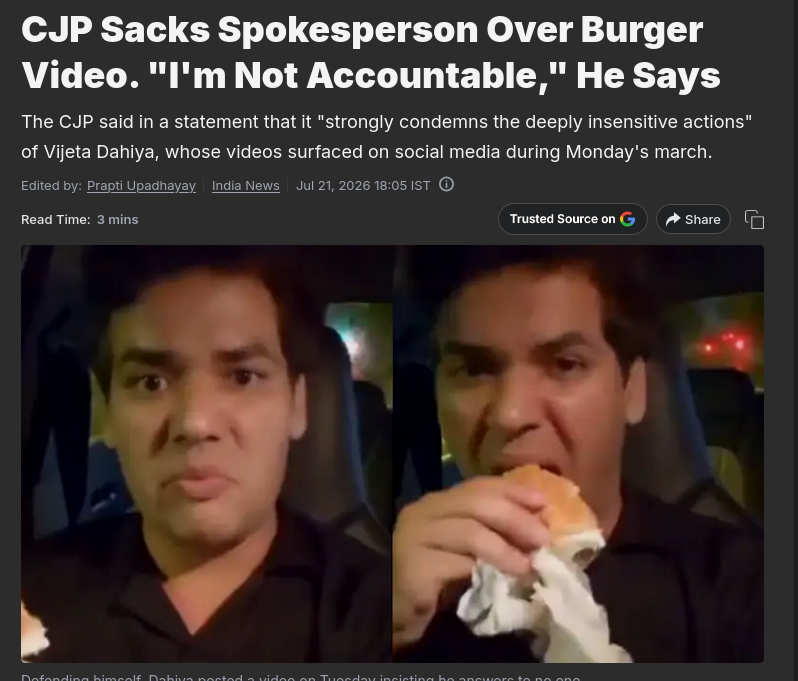
Some funny excerpts from the NDTV article, as well as another article from ThePrint.in on the same incident:
As debate rages over activist Sonam Wangchuk’s hunger strike, Cockroach Janata Party spokesperson Vijeta Dahiya has come under fire for eating a burger.
He added, “Whatever I am doing, I am doing it for the country, doing it by my own choice, and I am not accountable to anyone. And I will eat a burger.”
In the caption, he also updated his followers on the status of the burger that set off the brouhaha: “By the way, I didnt eat the burger, because I felt that it has maida and transfats, and maybe I should eat elsewhere.”
The protestors may lose the battle against Dharmendhra Pradhan and the BJP government, but I hope they never lose their sense of humor.